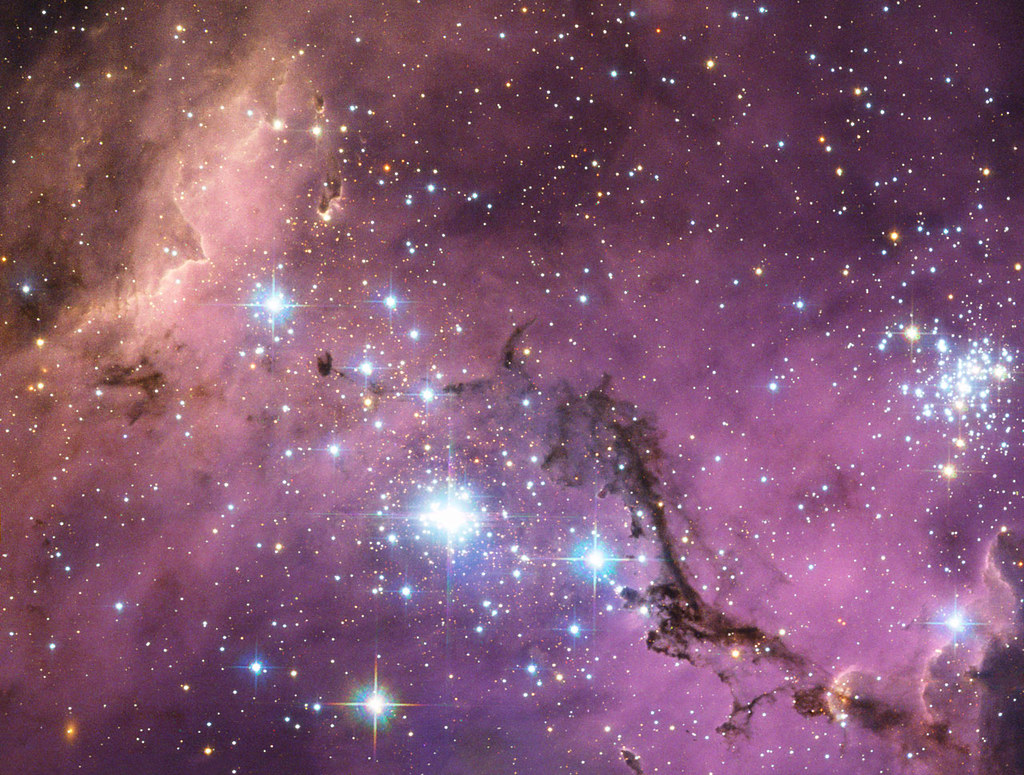
There is something quietly radical about stepping outside on a clear night and realising that every point of light above you is a sun — many of them ancient beyond comprehension, some surrounded by worlds we are only beginning to understand. Space has always done this to us: made us feel small, then inexplicably hopeful. In an age of relentless noise and short attention spans, the cosmos remains one of the few subjects that consistently stops people in their tracks.
A Universe Far Larger Than We Intuitively Grasp
The numbers involved in astronomy are almost deliberately difficult to picture. The Milky Way alone contains hundreds of billions of stars. The observable universe — the portion we can technically detect — stretches roughly 93 billion light-years across. And beyond that boundary? We genuinely do not know.
What makes this more than just abstract trivia is that astronomers and physicists are actively working to fill in the blanks. With increasingly powerful telescopes, both ground-based and orbiting, humanity is mapping the large-scale structure of the universe, studying how galaxies form and evolve, and hunting for the elusive signals of dark matter and dark energy — two phenomena that appear to make up the vast majority of everything that exists, yet remain stubbornly invisible and poorly understood.
Our Solar Neighbourhood: Familiar, Yet Still Full of Surprises
You do not need to venture beyond our own solar system to find jaw-dropping complexity. Take some of the remarkable features closer to home:
- Mars hosts the tallest known volcano in the solar system, Olympus Mons, which rises roughly three times the height of Mount Everest.
- Europa, one of Jupiter’s moons, is thought to harbour a vast liquid ocean beneath its icy crust — making it one of the more intriguing candidates in the search for extraterrestrial life.
- Saturn’s rings, while appearing solid from a distance, are composed of countless individual chunks of ice and rock, ranging from tiny grains to objects the size of a house.
- Venus, often called Earth’s twin due to its similar size, has a surface hot enough to melt lead and an atmosphere of crushing pressure and sulphuric acid clouds.
Even familiar objects reward closer inspection. The Sun, for instance, is not a simple ball of burning gas. It is a dynamic, roiling system of plasma and magnetic fields capable of unleashing solar flares and coronal mass ejections that can disrupt satellites and power grids here on Earth.
The Golden Age of Space Missions
We are living through what many consider a renaissance in space exploration. Government space agencies have been joined by a growing number of private organisations, creating a more competitive and faster-moving landscape than at any point since the early space race.
Robotic missions have become remarkably sophisticated. Rovers exploring Martian terrain can navigate autonomously, drill into rock, and conduct on-site chemical analysis. Orbiters study weather patterns, magnetic fields, and geological history across multiple worlds simultaneously. Probes launched decades ago are now venturing into interstellar space, transmitting data from distances so vast that signals take hours to arrive.
Human spaceflight, too, is undergoing a transformation. Plans for returning astronauts to the lunar surface and establishing longer-term habitats there have moved from science fiction to active engineering programmes. The Moon is increasingly viewed not just as a destination in itself, but as a proving ground for the technologies and physiological knowledge needed to eventually send people to Mars.
Why Any of This Matters to the Rest of Us
It is a fair question. When there are pressing problems here on Earth — health, poverty, climate — why should resources and attention flow toward distant rocks and empty space?
The honest answer is multifaceted. Space exploration has historically produced practical technologies that filter into everyday life, from advances in materials science and medical imaging to improvements in weather forecasting and global communications. Satellites already underpin vast amounts of modern infrastructure, often invisibly.
But there is also a more philosophical argument. Understanding the cosmos — how planets form, whether life exists elsewhere, how stars live and die — shapes how we understand ourselves. The realisation that Earth is a fragile, rare speck in an indifferent universe is not cause for despair; for many, it is precisely the kind of perspective that encourages greater care for this planet and greater curiosity about what lies beyond it.
The Invitation Is Open
You do not need a physics degree to engage meaningfully with space and astronomy. Amateur astronomers regularly contribute to scientific discoveries. Public outreach programmes make telescope time accessible in many communities. Online archives and live streams from space agencies bring mission footage and imagery to anyone with an internet connection.
The cosmos has always been there, patient and indifferent to whether we pay attention. But when we do choose to look up — really look — something shifts. Problems that felt urgent and immovable can momentarily seem their proper size against the scale of everything else. And somewhere in that recalibration, curiosity tends to win.
That, perhaps, is the oldest and most enduring gift of the night sky.
Image credits
- Hubble Sees Hidden Treasure in Large Magellanic Cloud — "Hubble Sees Hidden Treasure in Large Magellanic Cloud" by NASA Goddard Photo and Video is licensed under CC BY 2.0. To view a copy of this license, visit https://creativecommons.org/licenses/by/2.0/.
- A Lopsided Lynx — "A Lopsided Lynx" by NASA Goddard Photo and Video is licensed under CC BY 2.0. To view a copy of this license, visit https://creativecommons.org/licenses/by/2.0/.